

Multinational project with participants from Bulgaria, Switzerland, and Austria/Poland, supported by the Bulgarian National Scientific Fund (BNSF)
project contract No. КП-06-H 09/1
duration 36 months (2026-2029)
Project coordinator: Prof. Dr. Nikolay T. Tzvetkov
The term “NeuroTaCs” (Neuronal-Targeting Chimeras) is introduced for the first time by this project to designate a new type of biologically active molecules composed of two or more structural components – neuron-targeting chimeras. This is a new concept for multi-targeting chimeric small molecules, composed of three structural units, two of which comprising simultaneous biological action on key intracellular target mechanisms related to the processes of neurodegeneration. This concept is based on the principle of simultaneous inhibition of elevated levels of monoamine oxidase B (MAO-B) associated with neuronal mitochondrial dysfunction and oxidative stress, suppression of fibrillogenesis and degradation of already formed oligomers of a mutated variant of alpha-synuclein (a-Syn) protein, which is related to the neurotoxicity processes and neuroinflammation, as well as antagonism against the adenosine A2a receptor (A2aR), associated with increasing levels of dopaminergic neurons.
These proteins are widely distributed in the central nervous system (CNS) and periphery (PNS), where disruption of their normal function is mainly associated with Parkinson’s disease (PD), dementia with Lewy bodies, and other neurodegenerative conditions involving the accumulation of misfolded α-Syn (synucleinopathies), as well as dysfunctional conditions of the spinal cord and pain (Figure 1).
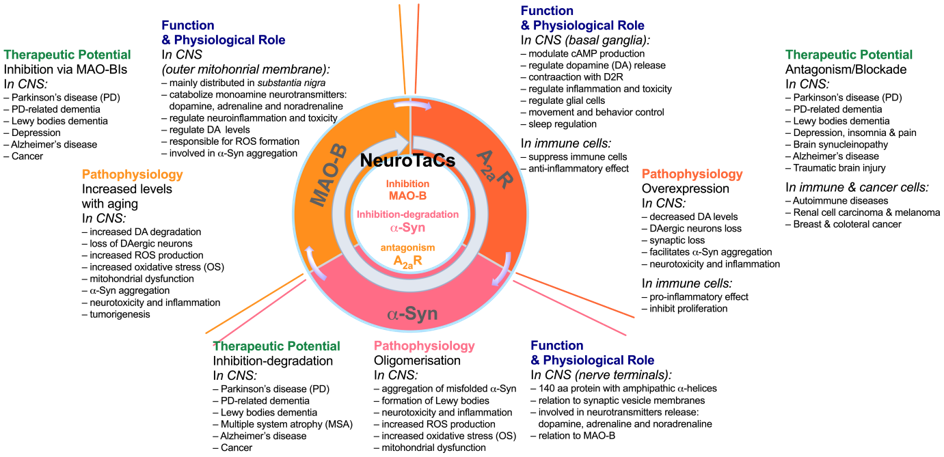
Figure 1. Main pathophysiological effects of MAO-B, a-Syn and adenosine А2а receptor and pharmacological effects in the therapy or diagnostics of various diseases.
In order to obtain the structures of NeuroTaCs chimeric molecules, the following steps are planned to be performed (Figure 2):
- Step 1 – Selection of suitable co-crystal structures of human MAO-A and B, mutated variant of a-Syn, human adenosine receptors of subtypes А1, А2а, А2b, and А3 using freely accessible PDB database (rcsb.org/). If not available, homology models of the respective human proteins will be generated using the corresponding orthologous protein sequences;
- Step 2 – Selection and generation of suitable NeuroTaCs chimeric molecules using the SCXRD/SeeSAR/HYDE platform, T-BDD methods, infiniSee, and a large set of libraries;
- Step 3 – Scoring, physicochemical evaluation, and ADMET analysis using HYDE scoring function in SeeSAR. This will serve to analyze the binding mode of virtually generated NeuroTaCs and will allow in silico assessment of their structure-activity relationships (SARs). This will enable us to select structural elements (lead structures) whose variation appears promising in terms of improved activity towards the main biological targets MAO-B, a-Syn, and A2a receptor;
- Step 4 – Synthesis of the top-scored in Step 3 NeuroTaCs molecules using 3–5-step synthetic strategy, for example, involves a consequently conjugation (liquid or solid-phase reactions) of modified structural units (modBB). This step 4 includes the stages of isolation, purification and structural characterization of the newly synthesized NeuroTaCs chimeric molecules;
- Steps 5 and 6 – Stability (chemical and metabolic, tautomeric forms), cytotoxicity, bioavailability (BBB) of the new synthesized NeuroTaCs molecules;
- Step 7 and 8 – In vitro assessment of monoaminergic inhibitory activity and mechanism of inhibition, ability to inhibit fibrillogenesis and aggregation of alpha-synuclein (a-Syn), neuroprotective and neuroregenerative effects;
- Step 9 and 10 – In vitro evaluation of binding affinities and functional analysis of newly obtained NeuroTaCs molecules as antagonists.
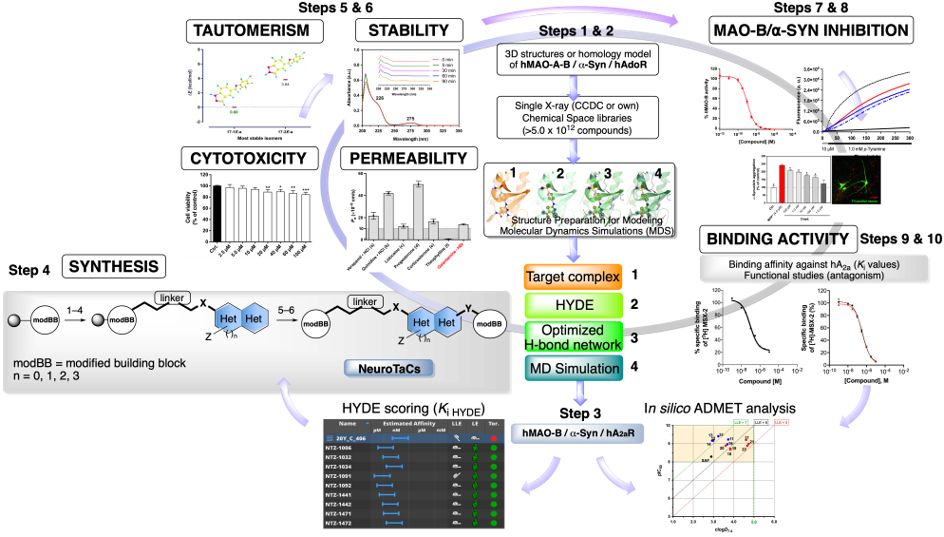
Figure 2. Main steps of the proposed research methodology.
The aims of the current project could be feasible due to an integral and interdisciplinary technology approach that we are tackling starting from using of available molecular modelling platform for in silico design, screening, validation, synthesis, and in vitro evaluation of novel chimeric molecules as selective, triple active inhibitors of MAO-B and α-Syn as well as adenosine A2a receptor antagonists.
For more information, please contact us at: ntzvetkov@bio21.bas.bg
Keywords: NeuroTaCs, MAO-B, a-Syn, A2aR, Multi-target drugs, Parkinson´s disease, Neurodegenerative diseases, Virtual screening