
FUTURE RESEARCH oriented to future prospective and search for partners
BEekeeping products valorizatiоn and biomonitoring for the SAFEty of BEEs and HONEY (BeSafeBeeHoney) (COST Action 22105)
DEVELOPMENT OF SMALL MOLECULAR ANTIBACTERIAL AGENTS AGAINTS PAENIBACILLUS LARVAE
Multinational project with participants from Bulgaria, Italy, Austria, and Poland, supported by the Bulgarian National Scientific Fund (BNSF)
project contract No. КП-06-COST/14
duration 24 months (2024-2026).
The current project (COST action CA22105, BNSF Project No. KP-06-COST/14) is related to the solution of a global problem – the dramatic decrease in the population of honey bees. This is a problem that affects the future of humanity as a whole. The topic is closely related to the development of new effective low-molecular antibacterial compounds that are selective against the bacterium Paenibacillus larvae. This pathogen is the causative agent of American Foulbrood Disease (AFB). AFB is a highly contagious disease of honeybee pilots (Apis mellifera) that is under safety control in many countries, but methods to treat this honeybee disease remain insufficiently effective. The used antibiotics so far are effective against the vegetative forms of the bacterium, but not against the formed spores. It is well-known that since ancient times, honey has been a popular functional food due to its health properties based on its composition of bioactive compounds with antioxidant, antimicrobial, anti-inflammatory, and anti-cancer properties. In addition, the European honey bee Apis mellifera is the most important pollinator, which is crucial for food and plant production in general. Honey bee populations are threatened with extinction not only in Europe, but also worldwide due to anthropogenic activities, including agricultural intensification, as well as the causative agents of various diseases and parasites.
The main goal of this project: Our primary goal is to develop the first-of-their-kind, non-toxic (not found in honey or honeybee by-products), selective, and innovative low-molecular-weight antibacterial agents with improved physicochemical properties. This would help enhance the reputation and professional standing of the young scientists involved in the development of these antibacterial agents.
Hence the following specific tasks:
- In silico design and virtual screening of drug-like small molecules structures using a novel, combined X-ray/modelling technology platform (SeeSAR/HYDE) that enable scoring, visualization and quantification of the docking results in form of HYDE estimated affinity ranges;
- Screening for antibacterial activity of the most prominent compounds against known bacterial strains including Paenibaccilus larvae and evaluation of selectivity in comparison with reference antibacterial agents;
- Establishment of biological assays and parallel in vitro pharmacological evaluation of the new small molecular antibacterial agents whether they interact with biological targets that are relevant for the bacterial survivor;
- Evaluation of cytotoxic effects of the selected small molecules, including in comparison with established reference drugs;
- Estimation of structure-activity relationships (SARs), more specifically, whether and how certain modifications in the respective scaffold, as well as in the side substituents will show both antibacterial and cytotoxic effects compare to standard single-target drugs and parent structures.
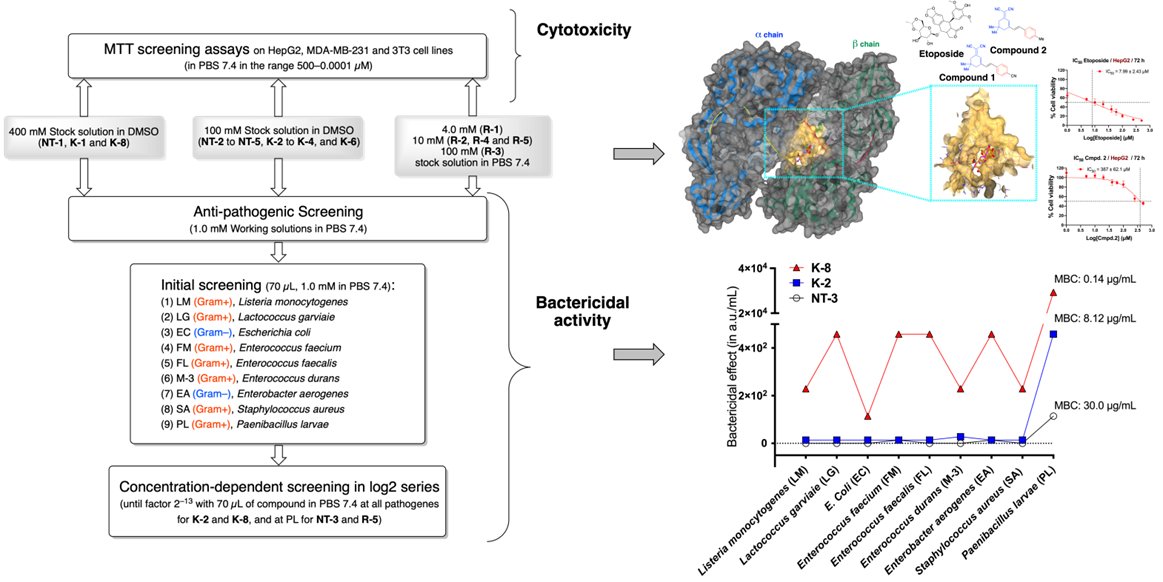
The aims of the current project could be feasible due to an integral and interdisciplinary technology approach that we are tackling starting from rational design of small molecular compounds, virtual screening, synthesis, biological screening and in relevant bacterial strains including Paenibaccilus larvae and in vitro evaluation of cytotoxic efficacy of the new generation antibacterial agents with possible anticancer activity. In the scope of our project, we also aim to create new collaborations for future oriented research not only in this specific area of human health and quality of life. The applied approach is illustrated as a part of our investigations in the Figure below.
For more information, please contact us at:
Assoc. Prof. Dr. Nikolay T. Tzvetkov
ntzvetkov@bio21.bas.bg
Keywords: Paenibacillus larvae, antibacterial and anticancer compounds, topoisomerase inhibitors, Bulgarian National Scientific Fund (BNSF).
—————